2.03.2020

The Financial Benefits Of Getting A Degree

If you’re thinking of going to college, or you’re considering undertaking further study, you might be weighing up the pros and cons. Is it really worth paying to do a degree, and will your investment appreciate in the future? If you’re at a crossroads, or you’re wondering which kind of program to take, this handy infographic offers an insight into the financial benefits of getting a degree.

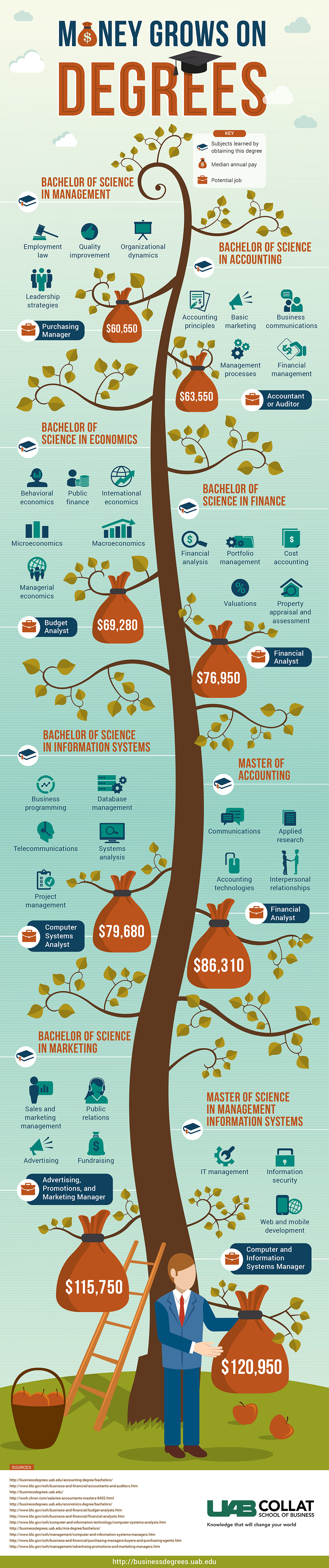
Studying is a means of investing in yourself, and often, gaining qualifications opens doors in the form of employment opportunities. The infographic below outlines some of the options you could explore by taking certain degree programs. 

Many people aspire to be a leader one day, and if this is a goal that resonates with you, a Bachelor of Science in Management may be an ideal option. This course offers training in employment law and organizational management strategy and it can lead to a diverse range of careers, for example, a purchasing manager with a median salary of $60,500. 

For those who have an interest in figures and statistics, a Bachelor of Science in Accounting might appeal. This course covers accounting principles and basic marketing, as well as financial management. The median salary for accountants and auditors is attractive at $63,550.

Moving up the tree, those with an eye for detail and an inquisitive nature could benefit from undertaking a program in Finance. A BSc in Finance covers everything from cost accounting and valuations to portfolio management. The median salary for a financial analyst is $76,950. 


Information is increasingly valuable for businesses and organizations, and a Master of Science program in Management of Information is an excellent option for those seeking to secure a bumper salary. The average wage for a Computer and Information Systems Manager is $120,950.


Infographic Design By University of Alabama Birmingham

1.31.2020

The Truth About Poverty Rates

There has been a great deal of debate about the role of politicians and policies and their impact on poverty rates in recent times. The truth is that despite the discussions and criticism, poverty rates in the US have fallen significantly.

As the infographic below shows, the proportion of people living in poverty fell from 27.3% in 1959 to 21.1% in 2014. In the last 40 years, personal income has almost doubled from an average of $17,292 in 1970 to $30,176 in 2014. 

The war on poverty has been an ongoing mission for US presidents throughout the ages. Franklin D. Roosevelt was credited with making a significant impact when introducing the Social Security Act of 1935, and this was followed by a host of developments designed to improve employment prospects, fund construction and innovation and provide relief for those in need. In 1965, Lyndon B. Johnson passed Social Security amendments, expanding benefits and launching Medicare and Medicaid and introducing measures, including food stamps, to raise the standard of living.

Poverty rates have declined across all demographics in the last 50 years, with the most significant change in rates among over 65s. 


More recently, continued improvements in Social Security have contributed to more than 21 million Americans being lifted out of poverty, with Medicare one of the main reasons adults are less likely to be out of pocket. At the age of 65, Medicare lowers the risk of experiencing difficulty paying medical bills and having to borrow money to fund treatment by 35%.


Infographic Design By this infographic about declining poverty rates

1.23.2020

How to Make a Difference in Healthcare


There are plenty of factors to consider when you’re thinking about which career you want to pursue. For example, you’ll need to think about motivation. It could be that you’re attracted to earning as much money as possible, or that you want to work in a position related to your passion, or anything else. One job requirement that is increasingly popular is that it must make a positive impact on the world. This has gained in popularity in recent years, because people have come to understand that making a positive difference in society is highly rewarding. And it makes sense that people with highly satisfying jobs are more content in their private lives too (the two, after all, are not isolated from one another).

If this is your aim, then it’s a good idea to look at the industry that does the most good: healthcare. But it’s not as if you need to become a doctor or a nurse to make a difference in this sector. Indeed, the position that makes the biggest contribution towards pushing the world of healthcare forward isn’t on the frontline at all: they’re behind the scenes. Healthcare executives are responsible for all manner of duties, many of which have a direct impact on the level of care that’s provided. For example, they can ensure that the value of treatment is fair, and help to control the cost of drugs.


If this is a position that interests you, find out more by checking out the info graphic below. 


Infographic Design By USC USC

LinkWithin

Related Posts Plugin for WordPress, Blogger...